
-
Publish Your Research/Review Articles in our High Quality Journal for just USD $99*+Taxes( *T&C Apply)
Offer Ends On
Publish Your Research/Review Articles in our High Quality Journal for just USD $99*+Taxes( *T&C Apply)
Offer Ends On
Philip L Millstein* and Carlos Eduardo Sabrosa
Corresponding Author: Philip L Millstein, Department of Restorative Dentistry, Harvard School of Dental Medicine, Boston, Massachusetts, USA.
Received: December 23, 2025 ; Revised: December 25, 2025 ; Accepted: December 27, 2025 ; Available Online: January 01, 2026
Citation: Millstein PL & Sabrosa CE. (2025) Prescribed Occlusal Contact Areas for Planned Restorations. J Oral Health Dent Res, 5(2): 1-3.
Copyrights: ©2025 Millstein PL & Sabrosa CE. This is an open-access article distributed under the terms of the Creative Commons Attribution License, which permits unrestricted use, distribution, and reproduction in any medium, provided the original author and source are credited.
Views & Citations
Likes & Shares
This paper describes a method for designing occlusal contact areas prior to crown fabrication.
Keywords: Occlusion, Contact, Intensity, Design.
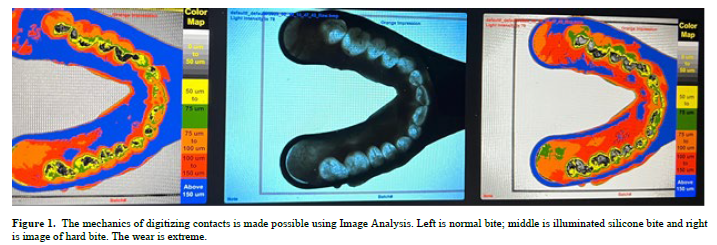
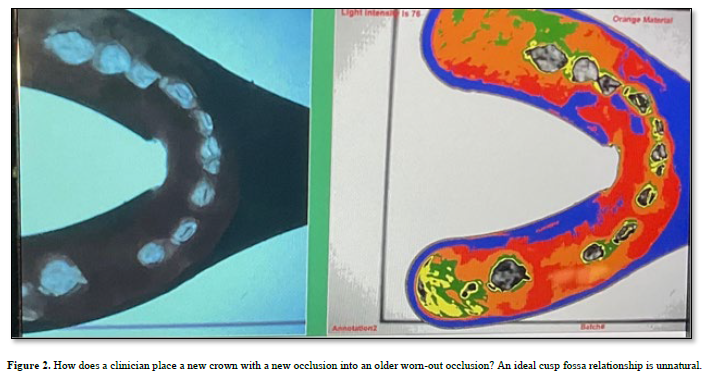
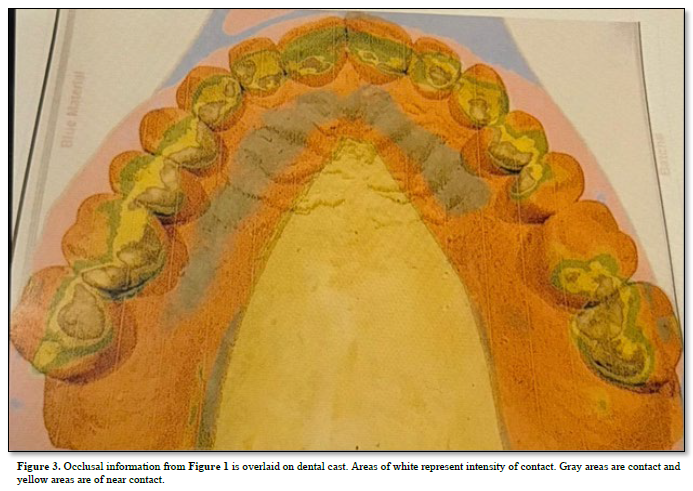
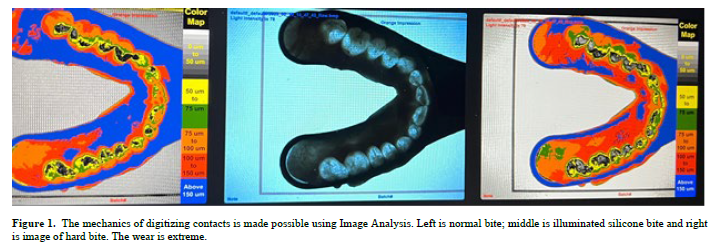
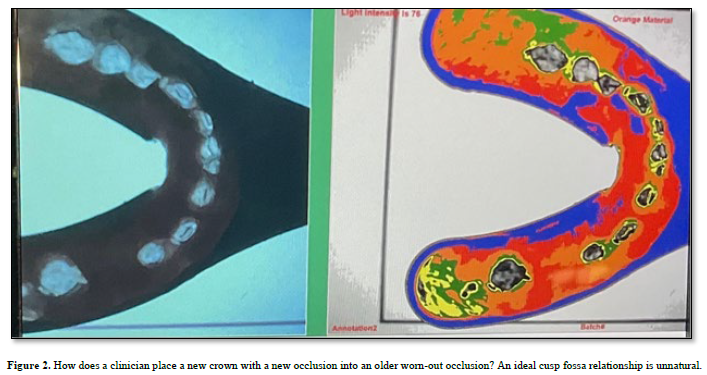
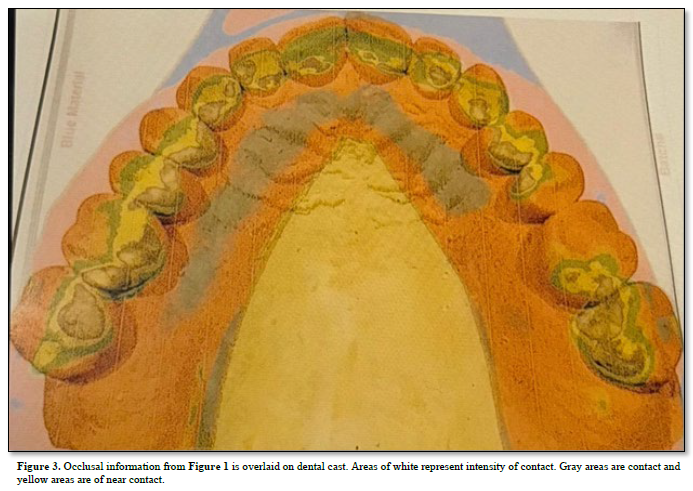
An occlusal contact area varies in size, shape and intensity (1). The surface area displays a roughness associated with the opposing contact surface. Contacts do more than contact. They can rub and abrade their counterparts as well as wreak havoc with a dentition (2). Where does a working occlusion function? Is it in a retruded position (CR), a central position (CO), or in between? (3). It is of interest to make a bite profile and overlay it on an actual working model. (Figure 1). One can study the contact areas along with their intensities and plan the anatomy of the contact areas to be replaced. This gives the dental laboratory a guide for restoring complex occlusal anatomy. Artificial Intelligence programs can record and design the contacts for the technician (4). Upon insertion of a restoration, areas of contact can be adjusted to fit into the working occlusion. It is the concept of placing a restoration into an established environment rather than inserting a new restoration into a worn dentition. (Figure 2) Using the surrounding occlusal contacts for reference one can design a new contact area that fits and adapts. (Figure 3) The rhythm of the functioning occlusion will not be disrupted (5). The contact areas work together. Most important is the design of the contact areas. If the contact areas do not fit at the time of cementation, then adjusting them may be of little value. The occlusal contact areas must be established prior to fabrication. Successful adjustments may then be made upon insertion. It is best to plan and build rather than build without a plan.
We use a triple tray and a non- set reusable silicone impression material for impressions (6). The flow properties of the silicone allow us to make functionally generated recordings if prescribed. Impressions take less than a minute. The impression is immediately processed. It is Illuminated on a light box and a photograph is taken by a camera six inches above the light box. The information is analyzed using image analysis (image J). The resultant black and white image is converted to color and the information is read from the accompanying computer screen. Profiles of the closed contact positions are digitized and stored (7). Occlusal contact areas are identified and design and treatment plans established. Planning is essential for success.

No Files Found


Internationally Accepted
Share Your Publication :